
How Freezone Companies Can Legally Operate in the UAE Mainland
Imagine this.
You run a successful freezone company in Dubai. Your clients are happy, your operations are smooth, and your costs are under control. One day, a mainland client approaches you for a direct contract. The opportunity is perfect but then reality hits. You remember the old rule: freezone companies can’t directly do business in the mainland without an agent or distributor.
For years, this limitation forced many business owners to either lose opportunities or spend heavily on setting up a separate mainland company.
That story has now changed.
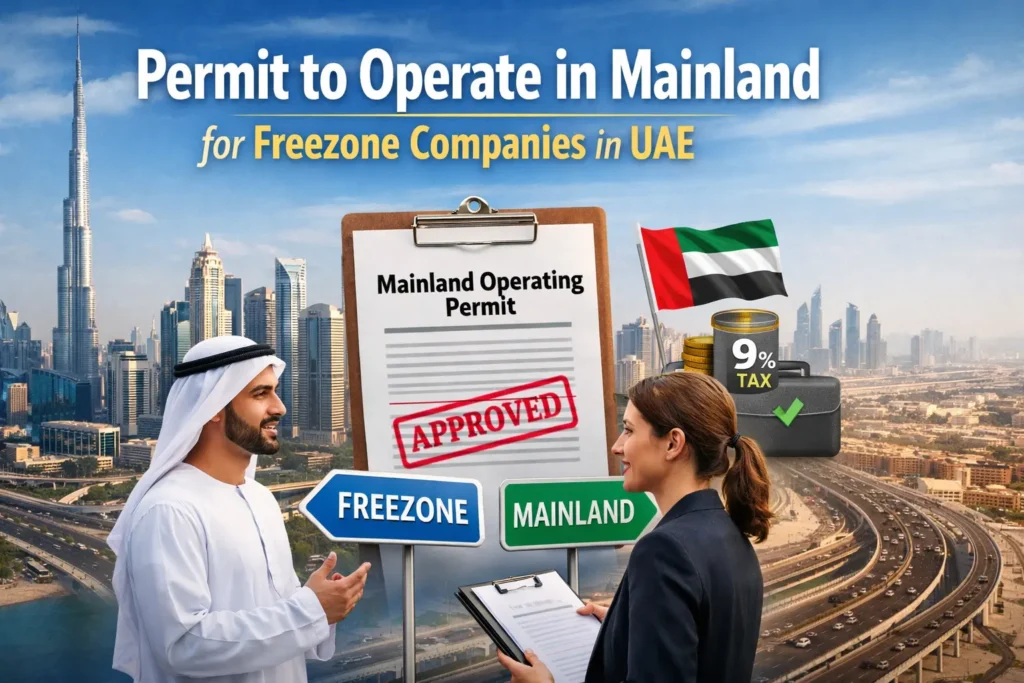
With the 2025 regulatory reforms, the UAE has introduced a clear and legal way for freezone companies to operate directly in the mainland without losing ownership, without closing their freezone entity, and without unnecessary complexity.
This article explains what the Permit to Operate in Mainland for Freezone Companies in UAE really means, who it is for, how it works, and why it matters to your business.
Why this change matters for freezone companies
Freezones were created to attract global businesses with benefits like 100% foreign ownership, simple setup, and tax incentives. However, one major challenge remained: restricted access to the mainland market.
Until recently, businesses had limited choices:
- Work through third-party distributors
- Appoint local agents
- Or set up a separate mainland company at a high cost
The new framework removes these barriers. It allows freezone companies to legally serve mainland customers directly, while still keeping their original structure intact.
For small and medium-sized businesses, this is not just a regulatory update it is a growth opportunity.
What is a mainland operating permit for freezone companies?
A mainland operating permit allows a freezone company to legally conduct approved business activities in the UAE mainland without forming a new legal entity.
Your company remains registered in the freezone.
Your ownership remains unchanged.
Your business history continues without interruption.
The permit simply gives you official approval to operate beyond the boundaries of the freezone.
The three ways freezone companies can operate in the mainland
The UAE now offers multiple routes depending on how much presence and flexibility your business needs.
1. Mainland operating permit – the most practical option
For most businesses, especially service providers and SMEs, this is the easiest and most affordable route.This permit allows direct mainland operations while keeping everything under your existing freezone company.
It is ideal if you want to test the market or serve clients without long-term commitments.
It works well for businesses in areas like IT services, consultancy, design, digital marketing, professional services, trading, and e-commerce.Instead of building a full mainland setup, you gain legal access quickly and at a predictable cost.
2. Branch license – for long-term mainland presence
If your business plans to work extensively in the mainland or needs wider operational scope, a branch license may be the better choice.
A branch is not a new company. It operates under the same name as your freezone entity and remains fully owned by it. However, it comes with more compliance requirements and, in some cases, the need for a physical office.
This option suits companies that already have strong mainland demand and want a permanent footprint.
3. Temporary activity permit – for short projects
Some businesses only need mainland access for a limited time. This could be for a specific contract, seasonal work, or a pilot project.
A temporary permit allows you to operate legally for a defined period without committing to long-term costs. It is especially useful for companies that want to explore opportunities before scaling further.
Key benefits of the new mainland access framework
This reform is designed to reduce friction, not add it. The benefits are practical and business-friendly.
First, cost efficiency.
Operating under a permit is far more affordable than setting up a new mainland company, especially when you consider office rent, licensing, and staffing costs.
Second, speed.
Approvals for non-regulated activities are usually completed within days, not weeks or months.
Third, ownership protection.
You keep 100% foreign ownership. There is no requirement for a local sponsor.
Fourth, business continuity.
Your contracts, brand reputation, and commercial history stay intact. There is no need to shut down or restructure your existing company.
Finally, flexibility.
You can start small, test the mainland market, and scale later if needed.
Who can apply and who cannot
Most non-regulated freezone companies are eligible, provided they hold a valid trade license and approval from their freezone authority.
Businesses in professional services, technology, consultancy, design, and trading usually qualify.
However, certain sectors are currently excluded or require additional approvals, such as:
- Healthcare and medical services
- Education institutions
- Regulated financial services
- Strategic or restricted goods
These exclusions are not permanent. Authorities have indicated that more sectors may be included in future phases.
How the application process works
The process is fully digital and designed to be straightforward.
First, you must obtain approval from your freezone authority. This confirms that your freezone allows you to operate outside its jurisdiction.
Next, you prepare standard company documents such as your trade license, incorporation papers, shareholder details, and identification documents.
Once ready, the application is submitted through the relevant government portal. After payment, approvals for eligible activities are usually issued quickly.
Once approved, you receive official confirmation that your company can legally operate in the mainland.
Tax and compliance: what business owners must understand
One of the most misunderstood areas is taxation.
Operating in the mainland does not remove your freezone tax benefits automatically. However, income earned from mainland activities is taxed differently.
Mainland revenue is subject to corporate tax under UAE law, while qualifying freezone income can still benefit from a 0% tax rate, provided strict conditions are met.
This makes separate accounting essential.
You must clearly track:
- Which revenue comes from mainland clients
- Which expenses relate to mainland operations
- Which income remains freezone-based
In simple terms, authorities want transparency. If records are unclear, tax benefits may be questioned.
VAT registration also applies if your taxable turnover crosses the threshold, regardless of whether income comes from freezone or mainland activities.
Common misconceptions that create confusion
Many business owners delay action due to incorrect assumptions.
One common myth is that operating in the mainland means losing freezone status. This is not true. Your freezone company remains active and unchanged.
Another misconception is that employees need new visas. In reality, staff under freezone visas can work on mainland projects without changing their employment status.
Some believe a physical mainland office is mandatory. For permit-based operations, this is often not required.
Finally, many think the process is expensive and complex. Compared to a full mainland setup, it is significantly simpler and more affordable.
Employees and workforce flexibility
The reforms also simplify workforce management.
You can use your existing team to support mainland operations without issuing new work permits or visas. This reduces administrative burden and allows faster scaling.
For growing businesses, this flexibility alone can save time, money, and effort.
Differences between Dubai and other emirates
Dubai follows a structured system through its economic department and digital platforms.
Abu Dhabi offers a dual licensing approach, especially for companies registered in financial freezones. This allows them to serve the mainland while operating from their freezone office.
Each emirate has its own procedures, but the overall direction is the same: integration, not restriction.
Why now is the right time to act
Authorities have made it clear that businesses already operating in the mainland without proper approval must regularise their status within the given compliance period.
Delaying action can lead to penalties, disruption, or missed opportunities.
On the other hand, early compliance gives your business confidence, legal clarity, and room to grow.
Final thoughts: a smart step forward for freezone businesses
The permit to operate in the mainland is not just a regulatory update—it is a strategic advantage.
It allows you to:
- Expand your customer base
- Serve clients directly
- Control costs
- Keep ownership intact
- Stay compliant with evolving laws
For busy business owners, this framework offers something rare: simplicity without compromise.If you are running a freezone company and planning to work with mainland clients or already doing so now is the time to take the right legal step.Understanding the correct permit, tax structure, and compliance requirements early can save you money, protect your business, and open new growth opportunities. Speak with a professional accounting firm and advisor who understands both freezone and mainland regulations to ensure your expansion is smooth, compliant, and future-ready.

